
Guideline: Provides guidance to regulated members to support them in the application of Standards of Practice.
Healthy Workspaces with Colleagues
October 1, 2026
Content Advisory Warning
The following content contains material that may be disturbing for some readers.
Topics covered include sensitive themes, such as harassment and bullying,
and other potentially triggering subjects.
Readers are encouraged to practice self-care when engaging with this guideline.
Introduction
The Alberta College of Speech-Language Pathologists and Audiologists (ACSLPA) is the regulatory body for the professions of speech-language pathology and audiology in Alberta. ACSLPA carries out its activities in accordance with provincial legislation to protect and serve the public by regulating and ensuring competent, safe, ethical practice of speech-language pathologists and audiologists.
The intent of this guideline is to support regulated members in developing and maintaining appropriate and responsible boundaries and healthy workspaces with their colleagues. Unhealthy workspaces, particularly in healthcare related environments, have become more apparent in recent years due to heightened awareness of safety in the workplace. Although regulated members may already have access to practice guidance or policies on respectful conduct (for example from their employer), this guideline focuses on the professional obligations of ACSLPA regulated members and how their professional boundaries with colleagues can affect safe, competent, and ethical service provision to the public. Healthy professional relationships support communication, collaboration, continuity of care, and the timely identification and resolution of concerns. Conversely, unhealthy professional boundaries with colleagues can interfere with professional judgment, information-sharing, teamwork, and the ability to act in clients’ best interests. For these reasons, guidance on professional conduct with colleagues is connected to ACSLPA’s public protection mandate.
Regulated members may also find it useful to review the following Key College Documents when reviewing this guideline:
- Standard of Practice 2.4 Professional Boundaries
- Standard of Practice 4.6 Human Resources
- Code of Ethics
Role of the College
ACSLPA does not regulate employers or members of other regulated professions. The College’s role is to establish and provide guidance on the minimum standards that apply to its regulated members, including expectations related to professional boundaries, respectful conduct, communication, and the protection of the public. Employer policies and processes may address the same conduct from an employment or operational perspective, while ACSLPA considers whether the conduct of an ACSLPA regulated member meets applicable minimum standards or is otherwise unprofessional conduct.
Depending on the circumstances, a regulated member may raise a concern with their employer, contact ACSLPA for professional practice advice, submit a complaint to ACSLPA about an ACSLPA regulated member, or pursue more than one of these options. Where a concern involves a person who is not regulated by ACSLPA, the College does not have the jurisdiction to regulate the person’s conduct, and another authority may be better positioned to assist, such as the employer, the person’s own regulatory body, a professional association or union, legal counsel, or the Alberta Human Rights Commission. ACSLPA can provide information about the professional standards that may apply to its regulated members but does not replace an employer’s responsibility to manage workplace operations or resolve employment matters.
Colleagues
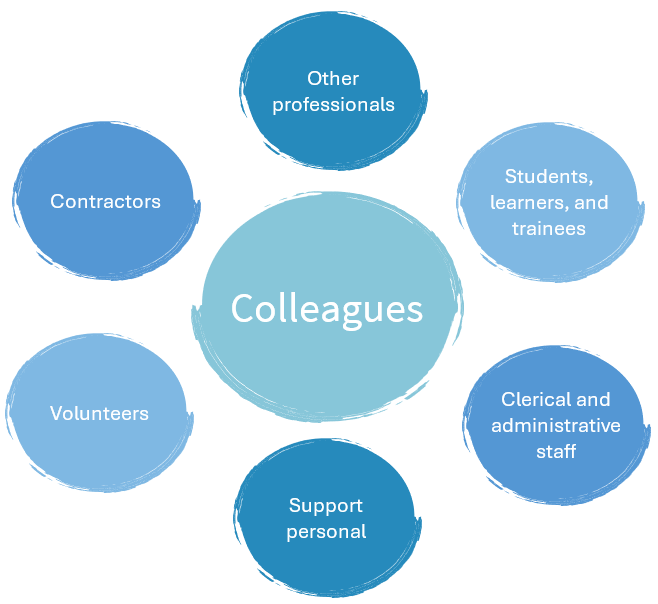
Colleagues include anyone that regulated members work with or alongside. This includes colleagues within or outside of one’s own organization:
Healthy Workspaces
Healthy workspaces are spaces where mutual respect, dignity, and collaborative work are created, supported, and maintained. In this guideline, a workspace includes any setting in which regulated members are providing professional services, including healthcare, education, private practice, community, academic, and other settings, whether in person, virtual/remote, or hybrid.
Healthy workspaces are characterized by civility, or showing regard for others by being polite, courteous, reasonable, and respectful. Civility is an important part of acting in a professional manner with both clients and colleagues. Regardless of their role in the workplace setting, ACSLPA regulated members have a shared responsibility for contributing to healthy workspaces.
Healthy workspaces are environments where:
- Everyone is treated fairly and feels respected and valued as an individual
- Working and learning spaces feel safe, and are free of discrimination, bullying, and harassment.
- A sense of inclusion is fostered, and people feel that their personal and individual differences are valued.
- There is clear communication between colleagues, characterized by colleagues feeling comfortable with asking questions, sharing ideas, admitting mistakes, talking about errors, and raising concerns safely, without fear of negative consequences, punishment, or humiliation.
- People can work effectively with their colleagues in the best interests of clients.
- Individuals are self-aware and can manage the impact they may have on others.
- Everyone takes responsibility for creating a healthy workspace.
- Workspace policies, procedures, reporting options, and expectations for respectful conduct are clearly communicated and made accessible.
Why Healthy Workspaces Matter
Healthy workspaces are violated when:
- The dignity or self-esteem of any individual is negatively impacted, and/or
- When an intimidating, hostile, or offensive work environment is created.
Regulated members should be aware that even what could be considered less significant or ‘minor’ violations (like eye rolling) can have negative impacts on an individual on the receiving end.
Healthy workspace violations can have considerable and harmful impacts on individuals, teams, and client care. These effects are not limited to staff experience or workspace operations. When colleagues do not feel safe to ask questions, share information, acknowledge errors, make improvements, challenge decisions, or raise concerns, important information may be delayed, withheld, or missed. Breakdowns in communication, trust, collaboration, and staff well-being can compromise clinical reasoning, continuity of care, identification and management of risk, and the ability to provide safe, effective, and client-centered services.
Exposure to healthy workspace violations can result in:
- Increased stress and anxiety;
- Increased burnout;
- Decreased attentiveness, engagement, and collaboration;
- Limited advancement in career pathways;
- Loss of trust in one’s management or leadership teams, employer, or organization;
- Decreased work satisfaction;
- Decreased productivity;
- Increased turnover and difficulties with retention and recruitment, leading to poor organizational or team sustainability;
- Increased incidences of harm or near harm, or neglect of client needs; and/or
- Workplace or regulatory college-based complaints.
Creating and Maintaining Healthy Workspaces
Healthy workplace violations can occur in any environment in which speech-language pathologists and audiologists practice, including healthcare, education, private practice, community, academic, and other settings. Certain workplace conditions may increase the risk of these behaviours, including high workloads, time pressure, high-stakes decision-making, unclear roles or policies, limited reporting supports, and workplace cultures in which disrespectful behaviour is normalized or not addressed, or in which provider wellness is not prioritized.
Hierarchical leadership structures, which are found in many workspaces in which healthcare practitioners work, can heighten power imbalances and make it more difficult for individuals to question decisions, raise concerns, or report harmful behaviour. Harmful conduct may also occur between colleagues at similar levels of authority, sometimes described as lateral or horizonal violence.[1] This may include behaviours such as verbal abuse, humiliation, intimidation, criticism, social or professional exclusion, discouragement, and withholding or denying access to information.[2]
Healthy workspace expectations apply regardless of a regulated member’s practice setting, role, or level of seniority. They also apply to in-person, virtual/remote, and hybrid work, including communication through email, messaging platforms, video meetings, shared electronic workspaces, and other work-related channels. Organizational factors can influence workplace culture, but it is the individual responsibility of each ACSLPA regulated member to contribute to healthy workspaces, whether in a leadership, management, or front-line role.
The following behaviours are expected of ACSLPA regulated members, regardless of their practice setting, work format (i.e., in-person or virtual), or role. Regulated members should note that violations of the expected behaviours below are particularly problematic when they are based on protected identity grounds, including race, religious beliefs, gender, disability, age, or other ground protected under the Alberta Human Rights Act.[3] Regulated members should also recognize that conversational styles, pacing, turn-taking, eye contact, tone, and communication patterns may differ across cultures, languages, and neurodivergent communication styles. Reflection and clarification are encouraged before assuming harmful intent.
- Maintaining and respecting the physical boundaries of colleagues. Physical boundary violations include:
- Using force to cause harm;
- Inappropriate physical contact or attempts at contact (e.g., striking, kicking, bumping); and/or
- The threat of force.
- Maintaining and respecting the emotional and psychological boundaries of colleagues. Violations of this nature include:
- Bullying[4], which generally involves a pattern of repeated behaviour, and harassment[5], which may involve one incident or a series of incidents;
- Verbal violations, e.g.,
- Name-calling;
- Yelling;
- Using obscene or offensive language;
- Teasing or ridiculing;
- Providing criticism in a way that is hostile, humiliating, or unrelated to legitimate performance management, supervision, guidance, mentoring, or feedback;
- Not giving a colleague opportunities to speak during conversations; and/or
- Making intimidating, threatening, condescending, or negative comments.
- Non-verbal violations, e.g.,
- Eye rolling;
- Purposely turning one’s back on a colleague during a conversation; and/or
- Other offensive gestures or tone of voice.
- Violations of others’ feelings of psychological safety, e.g.,
- Purposely embarrassing a colleague;
- Refusing to answer questions or withholding information related to practice, policy, workplace procedures, or client care when the information is reasonably required for safe and effective work;
- Purposely giving wrong information;
- Privacy violations, e.g., stalking, spying, or going through someone’s belonging;
- Using, displaying, or distributing materials that are offensive or a breach of the Alberta Human Rights Act;
- Taking steps to undermine a colleague’s workplace performance;
- Giving the silent treatment; and/or
- Gossiping or spreading rumours.
- Sexual boundary violations, including sexual harassment or any unwelcome sexual conduct or remarks. Please see the ACSLPA guideline Professional Boundaries: Prevention of Sexual Abuse & Sexual Misconduct for more information on boundary violations of this nature.
It is important to note that behaviour that is not intended to be disrespectful or violate boundaries such as those listed above can still have significant harmful impacts for the person on the receiving end. It is the result or impact of a behaviour that matters – if the behaviour is unwelcome, causes discomfort, humiliation, or embarrassment, or causes someone to feel degraded, then it is a healthy workspace boundary violation.
[1] See Registered Nurses’ Association of Ontario (2019) for further discussion of horizontal and vertical violence.
[2] See Bambi et al. (2018) for a review of workplace incivility, lateral violence, and bullying among nurses.
[3] The Alberta Human Rights Commission defines ‘protected grounds’ as the personal characteristics of individuals or groups of individuals that are protected from discrimination under human rights legislation. Please see the Alberta Human Rights Act for a full list of protected grounds in Alberta.
[4] Workplace bullying typically encompasses acts or comments that could psychologically hurt or isolate a person in the workplace and usually involves a pattern of behaviour that is meant to intimidate, offend, or humiliate a particular person or group of people (Canadian Centre for Occupational Health and Safety, 2026). Please see this link: https://www.ccohs.ca/oshanswers/psychosocial/bullying.html#section-3-hdr for more information on workplace bullying, including examples of bullying.
[5] Harassment can be defined as any unwanted or unwelcome verbal or physical contact that offends or humiliates a person and can involve one serious incident or a series of incidents (Alberta Human Rights Commission, 2026). Please see this link: https://albertahumanrights.ab.ca/what-are-human-rights/about-human-rights/harassment/ for more information in harassments, including examples of harassment.
Responding to Healthy Workspace Violations
ACSLPA acknowledges that being a target of any of the healthy workspace violations listed above can have significant impacts on an individual. Regulated members who find themselves in such a position can consider:
- Prioritizing your safety – immediately remove yourself from the space if necessary and if it feels safe to do so. Seek out a trusted person or persons or mental health or other relevant professionals for support.
- ACSLPA recognizes that being in a position of having to advocate for yourself after having been a target of healthy workspace violations can place additional unnecessary stress on an individual. It must also be acknowledged that it is not always safe to speak out, and that additional barriers to speaking up may exist for individuals who are internationally educated, racialized, multilingual, Indigenous, neurodivergent, disabled, in precarious employment positions, or navigating power imbalances related to culture, language, identity, or professional hierarchy. If available to you, consider seeking out a support person. This does not have to be someone in the workspace or another professional. This can be a family member or friend who is willing and able to help advocate on your behalf and in your best interests (e.g., listening to your concerns and feelings and offering advice, helping with correspondence about the matter to your employer, attending meetings about the matter with you, etc.).
- Documenting the behavior(s) of concern. This may be needed for review or intervention processes later on but may also be helpful as you clarify and process the issue.
- If you feel safe and comfortable to do so – engage with workplace supports (e.g., Human Resources or your management or site-specific reporting mechanisms).
- Only if you feel safe and comfortable to do so – speak to the person responsible to address the concerning behaviours. You can let them know their behaviour is disrespectful and ask them to stop.
- Seek external advice or support (e.g., ACSLPA, employee assistance programs, legal counsel, professional associations or unions, or the Alberta Human Rights Commission if necessary).
ACSLPA acknowledges that witnessing healthy workspace violations can be distressing and places regulated members in difficult positions in the workplace. However, members are reminded that ignoring or silently observing healthy workspace violations may send the message that the behaviour is acceptable. Some steps that can be taken in these types of situations include:
- Checking in and offering support to anyone targeted or affected by healthy workspace violations. You can let them know the behaviour you witnessed was unacceptable, and that you can be available to provide your perspective as a witness if needed.
- Only if you feel safe and comfortable to do so – address the behaviour directly with the person responsible. You can let them know their behaviour made you uncomfortable and ask them to stop.
- If you feel safe and comfortable to do so and only with the consent of the person who was targeted – consider reporting the behaviour to your employer in accordance with any relevant policies or procedures.
- Bringing forward to your employer any policy or procedural changes you think are necessary given your experience with the violation event(s).
- Seeking support for yourself – this can be a family member or friend, trusted colleague, mental health professional, or a formal workplace support professional (e.g., Human Resources) for support and advice as needed.
Regulated members in management and leadership positions are expected to address healthy workspace violations promptly and in accordance with any employer policies and ACSLPA’s Standard of Practice: Human Resources. Regulated members who are responsible for the management of employees should consider creating or amending healthy workspace policies if their workplace does not have applicable policies, or if the policies in existence do not adequately support the maintenance of healthy workspaces. They should also take reasonable steps to ensure that staff and learners are informed about relevant workplace policies, behavioural expectations, reporting pathways, and available supports, and that these are applied consistently and fairly.
Being informed that your behaviour may have violated healthy workspace boundaries may be upsetting. Regulated members in this position are strongly encouraged to:
- Stop the offending behaviour immediately
- Reflect to understand how your behaviour could have had a negative impact on someone.
- Seek support for yourself, e.g., a family member or friend, trusted colleague, mental health professional, or a formal workplace support professional (e.g., Human Resources) for support and advice as needed.
- Inquire with your manager, or workplace supports (e.g., Human Resources) on how you can rectify the matter. Honour the wishes of the affected person if they do not wish to interact with you directly during the resolution of the matter.
Regulated members are reminded that they may contact ACSLPA for professional practice advice or questions about the professional expectations in this guideline. They may also use applicable employer reporting processes, and, in some circumstances, may choose to pursue both workplace and regulatory pathways.
References
Alberta Human Rights Commission. (2026). Harassment. https://albertahumanrights.ab.ca/what-are-human-rights/about-human-rights/harassment/
Bambi S, Foà C, De Felippis C, Lucchini A, Guazzini A, Rasero L. (2018). Workplace incivility, lateral violence and bullying among nurses. A review about their prevalence and related factors. Acta Biomed. 2018;89(6-S):51-79. https://doi.org/10.23750/abm.v89i6-S.7461
College of LPNs and HCAs of Alberta. (2026). Standards of practice for HCAs on professional boundaries. https://www.clha.com/hca/hca-news/standards-of-practice-for-hcas-on-professional-boundaries/
General Medical Council. (2026). Domain 3: Colleagues, culture, and safety. https://www.gmc-uk.org/professional-standards/the-professional-standards/good-medical-practice/domain-3-colleagues-culture-and-safety
Canadian Centre for Occupational Health and Safety. (2026). Bullying in the workplace. https://www.ccohs.ca/oshanswers/psychosocial/bullying.html#section-3-hdr
Health & Care Professions Council. (2026). Maintaining professional boundaries. https://www.hcpc-uk.org/standards/meeting-our-standards/person-centred-care/maintaining-professional-boundaries/
Holroyd-Leduc, J. M., & Straus, S. E. (2018). #MeToo and the medical profession. Canadian Medical Association Journal, 190(33). https://doi.org/10.1503/cmaj.181037
Registered Nurses’ Association of Ontario. (2019). Preventing Violence, harassment and bullying against health workers (2nd ed.). https://rnao.ca/bpg/guidelines/preventing-violence-harassment-and-bullying-against-health-workers
University of Alberta Department of Medicine. (2013). Working with respect: Guidance document. https://www.ualberta.ca/en/department-of-medicine/media-library/faculty-staff/generalinfo/workingwithrespect-2016.pdf