

Continuing Competence Program Risks & Supports 2025 Data

October 2026
As part of the Continuing Competence Program (CCP), registrants are required to reflect on factors that may pose risks to and support their competence to practice. Currently, there is limited data specific to the speech-language pathology and audiology professions regarding perceived risks and supports to professional competence. The following findings provide insight into registrants’ perspectives based on 2025 CCP submissions.
Risks to Competence
The list of risks to competence and their definitions are presented below:
| Risk | Definition |
|---|---|
| Adequacy of practice prep | Inadequate preparation from previous education programs, for example, little to no coursework in specialized clinical areas, or outdated knowledge base. |
| Caseload/Workload volume | Risks to competence associated with high caseload or workload volumes (inclusive of service provision, administrative tasks, and all other tasks associated with SLP or Audiologist role). |
| Equity & inclusion | Barriers to providing culturally and linguistically appropriate service provision, for example, a lack of adequate resources (e.g., interpreters, assessment tools in other languages), a lack of information (e.g., developmental or cultural norms), or a lack of training (e.g., cultural awareness, responsiveness). |
| Lack of clinical exposure | Gaps in knowledge in specific clinical areas due to insufficient opportunity to gain experience in these areas, such as a lack of clinical exposure or experience with special populations on caseload. |
| Lack of engagement in profession | For example, disconnection from colleagues, clients, and/or the profession, or being ‘stuck in a rut’. |
| Lack of Resources | Availability of money, materials, and other assets required to function effectively, such as insufficient human resources, financial resources, equipment, materials, or time. |
| Limited specialized training | Absence of formal training when working with special populations or when engaging in specialized areas of clinical practice. |
| Practice environment | Organizational features that may constrain practice, such as ineffective team communication and collaboration, a lack of autonomy to practice, a lack of peer or colleague support network, or instability due to high staff turnover |
| Previous disciplinary action | Previous complaint or disciplinary action against the regulated member by regulatory body or employing organization, for example, that may affect the regulated member’s confidence to practice. |
| Professional isolation | A lack of regular interactions with colleagues and peers, or a lack of a professional network. |
| Transitions | Any change in work status such as a change of setting, position, or scope of practice, for example, transitioning into the workforce as a new graduate, returning to active practice, or moving between jurisdictions. |
| Wellness | Physical or mental health and well-being factors that can affect service delivery, for example, illness, chronic conditions, anxiety, stress, cognitive decline, depression, fatigue, work-life balance, addiction, limited access to supports. |
| Other | – |
Data from the 2025 CCP around risks to competence:
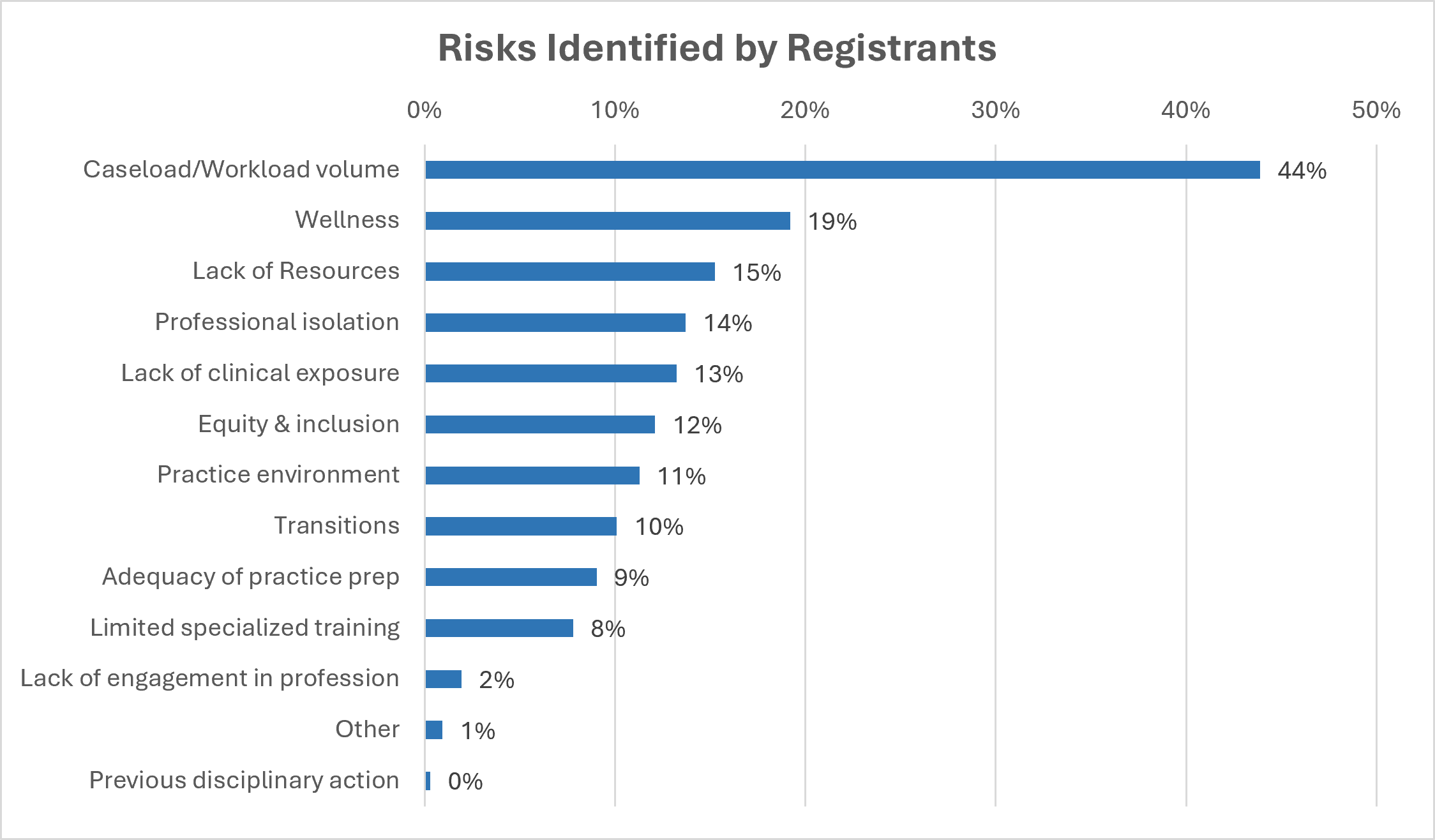
Among the risk factors available for selection, caseload/workload volume was identified most frequently, with 44% of registrants reporting it as a risk to their competence. It is important to note that ACSLPA can report only on the data collected and cannot draw conclusions about the causes or implications of these findings. This result is consistent with the 2022 data, when 41% of registrants identified caseload/workload volume as a risk.
Wellness was the second most frequently identified risk factor with 19%. While it was selected less than half as often as caseload/workload volume, it remains a notable concern identified by registrants. This finding is also consistent with the 2022 results, when 17.7% of registrants identified wellness as a risk to competence.
Other commonly identified risks included lack of resources (15%), professional isolation (14%), and lack of clinical exposure (13%), all of which were reported at similar rates.
The finding related to professional isolation highlights the importance of having colleagues and professional networks available for consultation and support. This aligns with existing literature, which suggests that limited access to peer support can be a significant risk to competent practice.
It should be noted that the percentages reported exceed 100%, as registrants were able, but not required, to select more than one risk factor.
Supports to Competence
The list of supports to competence and their definitions are presented below:
| Support | Definition |
|---|---|
| Assessment and feedback | Use of tools to evaluate professional and clinical practice, growth and development, for example, self-reported or peer or supervisor feedback. |
| Clinical exposure/experience | Regular clinical exposure/experience with specific populations on caseload. |
| Continuing education/professional development | Participation in educational activities during the practice year |
| Educational information/program | Adequate education or foundational knowledge in specific practice areas, such as specialized coursework or training. |
| Personalized support and feedback | Mentorship, coaching, or feedback to improve knowledge and/or skills |
| Professional organization participation | Participation in committee or taskforce work with a regulatory body, employer, or association. |
| Quality assurance activities | Participation in workplace or professional quality assurance programs or quality improvement initiatives. |
| Reflection and self-assessment | Introspection, personal analysis, and consideration of knowledge, skills, attitudes, judgment, and/or practice |
| Support through employer | Policies and processes that develop or maintain competence, such as practice supervision or mentorship, communities of practice, or support for continuing education. |
| Technology | Technological means to develop or maintain competence or improve practice such as digital administration of standardized assessments, advances in amplification devices, or opportunities for simulated case studies. |
| Wellness | Any actions that promote personal health and well-being, and may positively affect service delivery. |
| Other | – |
Data from the 2025 CCP around supports to competence:
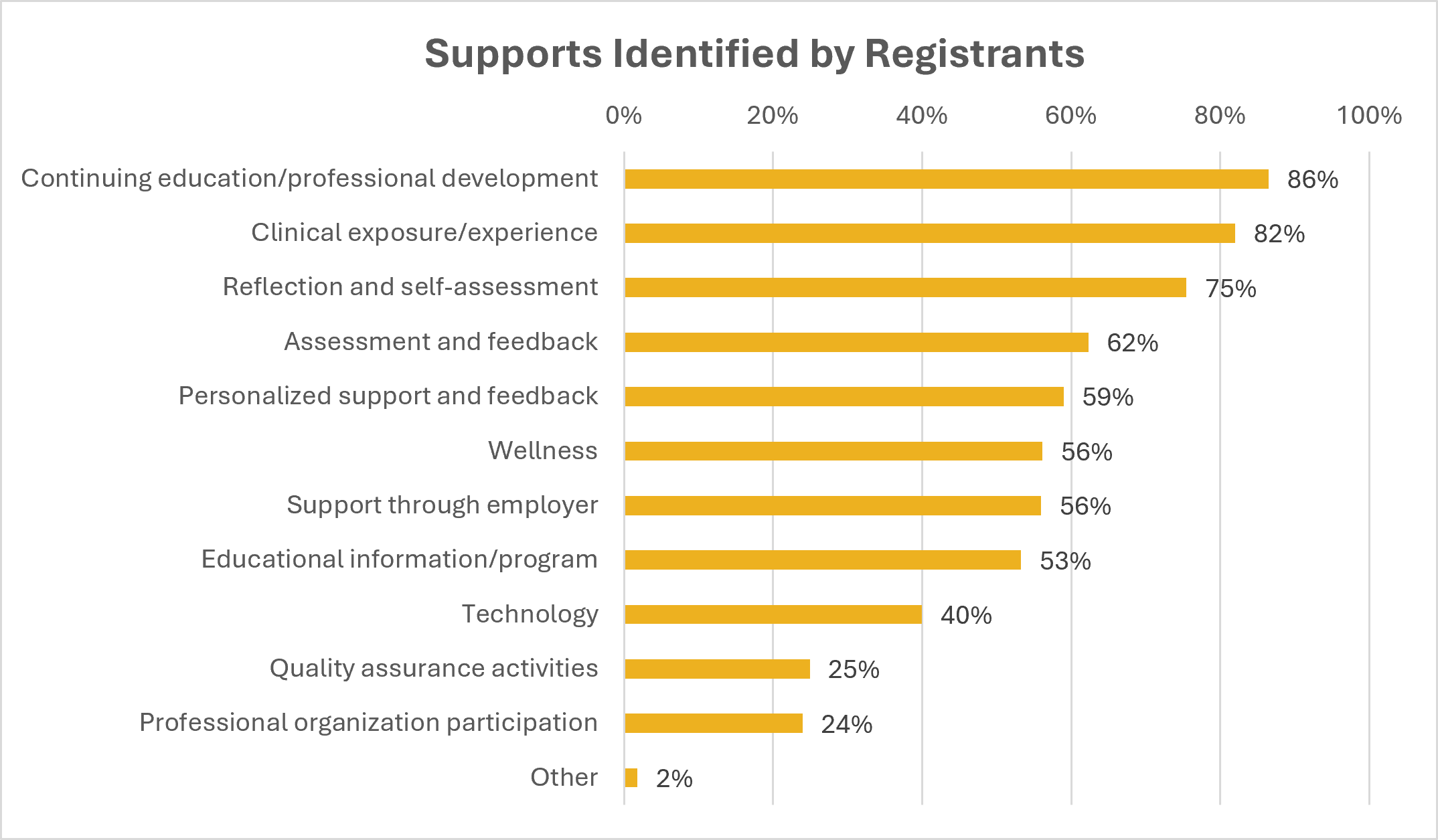
When asked about factors that support their competence, registrants most frequently identified continuing education and professional development (86%), clinical exposure and experience (82%), and reflection and self-assessment (75%).
Additional supports identified by a substantial proportion of registrants included assessment and feedback (62%) and personalized support and guidance (59%).
These findings are consistent with the literature, which identifies participation in continuing competence and professional development activities as key supports to maintaining professional competence. The literature also highlights the value of access to peers and colleagues for consultation, feedback, and ongoing professional support.
It is also encouraging to note that 56% of registrants identified personal wellness and self-care as important supports to their professional competence. This suggests that many registrants recognize the connection between personal well-being and the ability to provide safe, competent, and ethical care.
It should be noted that the percentages reported exceed 100%, as registrants were able, but not required, to select more than one support to competence.
If you found this article interesting, all of our Competence Corner publications can be accessed here. If you have questions about these topics, please email ACSLPA via our Contact Us Form or call 780-944-1609.
If there is a conflict or discrepancy with the information or advice set out on this webpage and the information contained in a more official ACSLPA document, then the information contained in the more official ACSLPA document applies and not the information or advice set out here. For the purposes of this disclaimer, ACSLPA’s more official documents include the governing legislation (including the Health Professions Act and the Speech-Language Pathologist and Audiologist Profession Regulation) as well as ACSLPA’s Bylaws, policies, Standards of Practice, Code of Ethics, manuals and/or any other official document approved by Council, a statutory committee or a college official. Persons interacting with ACSLPA are responsible for reviewing and familiarizing themselves with the relevant information contained in ACSLPA’s official documents.